Mwenendo
African Economy
Growth, inflation, rates, tax, debt, trade, jobs and the cost of living.
North America Slips: Kenya's August Remittances Rise as Europe and Other Regions Gain
Kenya received about KSh58.6B (US$451.85M) in diaspora transfers in August, 6% more than a year earlier, according to the Central Bank's monthly data series. The 12-month total still fell 1.3% to KSh650.4B (US$5.013B), down from KSh659.0B (US$5.079B), using the same October exchange rate for comparison between the two periods. North American transfers dropped about 12% year on year, while Europe rose 24% and the rest of the world gained 42%, according to CBK source-market figures. The regional split explains how the monthly total could rise while annual inflows declined, but the data do not identify why each corridor moved differently.
CBK Reserves Ease to KSh1.915T, Still Cover 5.9 Months of Imports
Kenya’s foreign-exchange reserves fell to KSh1.915T ($14.736B) on 8 October, down from KSh1.940T ($14.930B) a week earlier, the Central Bank of Kenya reported in its latest bulletin. The stock still covered 5.9 months of imports, above the central bank’s statutory minimum of four months and providing a buffer against external payment shocks. The shilling traded at KSh129.94 to the US dollar on 8 October, compared with KSh129.71 on 1 October, according to the same weekly bulletin.
Credit Growth Picks Up: Private Sector Lending Rises to 10.6 Per Cent
Commercial banks’ lending to the private sector grew 10.6 per cent year-on-year in September 2026, up from 10.3 per cent in August, according to the Central Bank of Kenya. Average commercial banks’ lending rates stood at 14.4 per cent in September, compared with 14.3 per cent in August and 17.2 per cent in November 2024. Growth remained strong in trade, building and construction, agriculture, finance and insurance, and consumer durables, reflecting improved demand for credit.
Rwanda's Producer Prices Rise 21.1 Per Cent in a Year, With Exports Rising Fastest
Rwanda's Producer Price Index, which tracks what producers receive for local and export goods, rose 21.1 per cent in the year to August 2026, up from 20.8 per cent in July. Export producer prices climbed 25.1 per cent year on year, well above the 18.9 per cent rise in prices of locally sold products, according to Rwanda's statistics office. Despite the high annual rate, the overall index fell 0.2 per cent from July to August, a reminder that yearly and monthly figures can point in different directions.
Tanzania's Inflation Holds at 4.3% as Food Price Growth Edges Higher
Tanzania's annual consumer inflation remained at 4.3% in September 2026, unchanged from August, according to the National Bureau of Statistics. Annual inflation for food and non-alcoholic beverages rose to 3.9% from 3.7%, while inflation excluding those items stayed at 4.6%. The unchanged headline rate does not mean prices stopped rising, and households with different spending patterns may experience different pressure on their budgets.
Kenyan Banks' Average Lending Rate Stood at 14.34% in August
The Central Bank of Kenya's August figures put the average lending rate at 14.34%, while the average deposit rate stood at 6.91% and the savings rate at 3.54%. The three measures describe different sides of banking, and none guarantees the rate an individual borrower or saver will receive from a specific institution. The published panel supplied for this assignment does not provide a previous-month comparison, so the figures cannot establish whether average borrowing costs rose or fell in August.
Kenya Mobile Money Transactions Rise to KSh 728.7 Billion
Kenya’s mobile money transaction value rose to KSh 728.7 billion in July from KSh 682.5 billion in June, according to the national statistics agency. The number of transactions increased to 221.1 million from 212.5 million, while reported mobile money accounts edged up to 94.4 million from 94.2 million. Account totals are not a count of unique active users, and the published figures do not identify which payment types drove the monthly increase.
South Africa’s Factory Price Inflation Eases to 5.0% in August
South Africa’s annual producer price inflation eased to 5.0% in August from 5.7% in July, while the index fell 0.4% month on month. Producer prices track prices received by manufacturers, not the prices households pay in shops, so slower factory-gate inflation does not guarantee cheaper goods. Businesses will need detailed product data and supplier quotations to establish whether the national trend is easing costs for the materials and goods they buy.

UNCTAD Cuts 2026 Global Growth Forecast to 2.6% as Energy Costs Rise
UN Trade and Development expects global growth to slow to 2.6% in 2026 from 2.9% in 2025. Higher energy costs and weaker external demand pose risks for African importers, businesses and households.
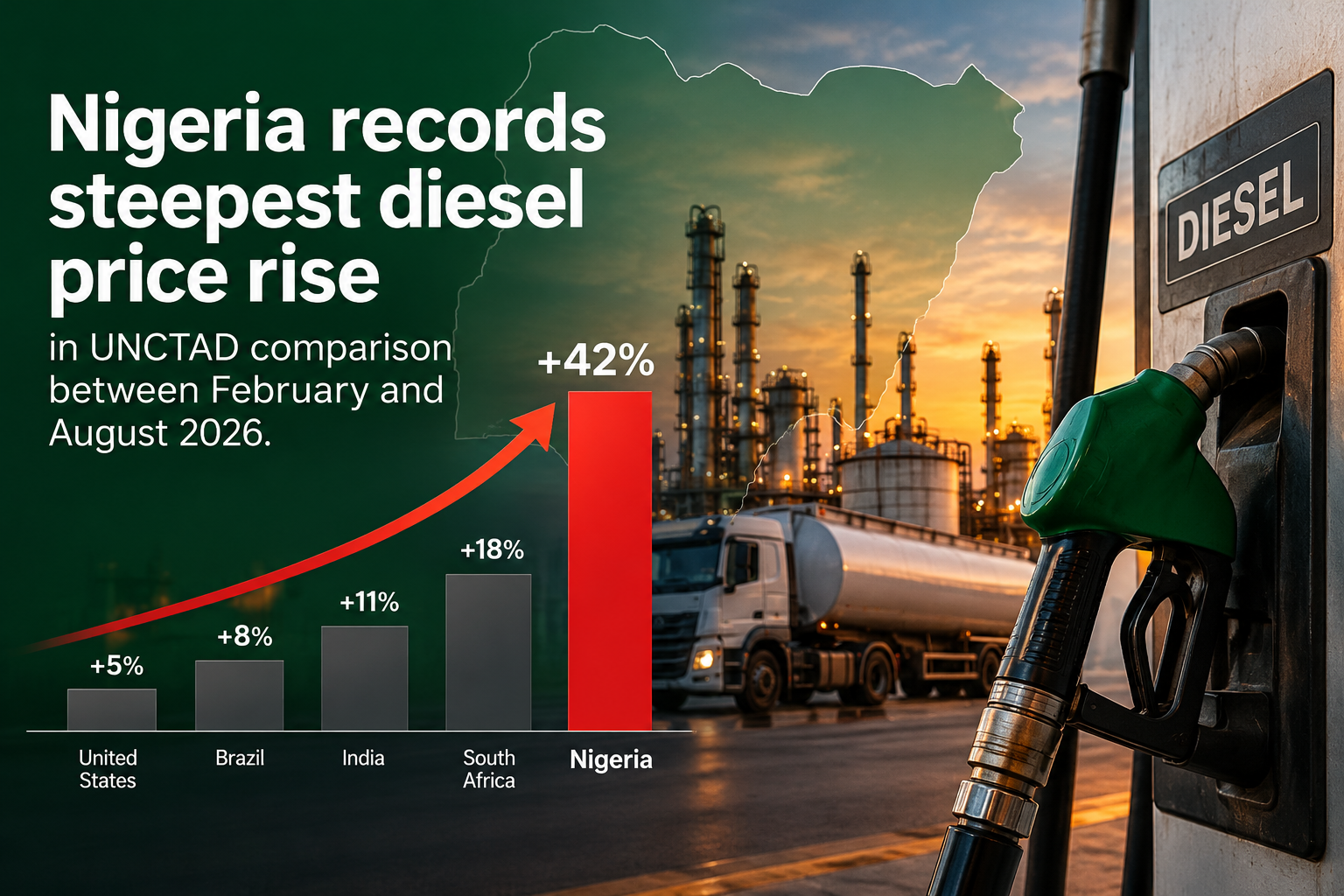
Nigeria’s Diesel Prices Rise 82.7% as Global Fuel Shock Bites
Nigeria recorded the steepest diesel price rise in UNCTAD’s comparison between February and August 2026. The figures show how global energy disruption has fed into domestic fuel costs, even as local refining and a short petrol discount offer partial relief.

Kenya’s KSh 662B Digital Economy Forecast Faces Internet and Trade Barriers
Kenya wants more small firms to trade across borders online, but connectivity, finance and delivery costs remain obstacles. The KSh 662 billion GDP figure is a 2024 forecast for 2028, not a confirmed result or new funding pledge.
Trump Announces Russian Diesel Supply Deal as US Eases Sanctions
Donald Trump says Russia will supply diesel to US and global markets, while the US Treasury has authorised specified transactions involving Russian-origin diesel through 7 April 2027. Payment arrangements, buyers and delivery details remain unclear, and the price impact is not yet established.
The First Receipt: The Pump Pays Before Anyone Else When Oil Jumps
A dearer barrel hits the pump first, then the matatu, then the price of unga and a factory input. Kenya used 8.41 per cent more petroleum in the year to June. The levy sits on every litre. The Central Bank has already named Middle East oil as the risk it is watching. A Lamu refinery does not repeal the world price if the crude is imported.
A Coast Asked to Host: Lamu Takes a Refinery Kenya Cannot Fill
Lamu is being asked to host a 700,000-barrel plant that Kenya's own fields cannot feed. Turkana, even at a planned peak, covers only a sliver. The other barrels must come by ship. The land fight is already in court. The crude question is not. A ribbon in Lamu is not cheaper fuel in Nairobi.
Two Borrowers, Two Prices: The Loan Formula Banks Are Now Using
A variable shilling loan is priced as KESONIA plus a premium the Bank calls K, then fees on top. K covers the bank's lending costs, a return for shareholders, and the borrower's own risk. New variable loans have used the formula since 1 September 2025. Older ones switched on 28 February 2026. The same bank can charge two customers different rates if it judges their risk differently.
In the Account: Tea Factories Release September Pay and the Bonus
KTDA chairman Enos Njeru said on 9 October that September pay and the second payment had been sent to farmers' accounts. Growers can draw the money from Monday 12 October, because Saturday is Mazingira Day and banks are shut. Bonus rates this year run from about KSh 12 to KSh 50 a kilogramme, depending on the factory. A factory-by-factory list that circulated in September was marked fake by the agency.
A Small Cheque: China Gives Kenya KSh 258 Million for Ebola and Drought
China handed Kenya $2 million, about KSh 258 million, on 8 October for Ebola readiness and drought relief. Half, about KSh 129 million, is for high-risk counties. Half is for the drought. Ambassador Guo Haiyan and Treasury Principal Secretary Chris Kiptoo signed the handover. The first imported Ebola case, a Bundibugyo infection, died in Nairobi this week.
A Bigger Float: Phones Moved KSh 728.70 Billion in July
Mobile-money value rose to KSh 728.70 billion in July, from KSh 682.50 billion in June. Transactions rose to 221.10 million, from 212.50 million a month earlier. Reported accounts were 94.40 million, against 94.20 million, and that is not a count of people. The same wallet now also takes a KSh 100 Shari'ah fund and a phone loan.

A Shift in Credit Sentiment: Moody's Turns Positive on Sub-Saharan Africa Outlook
Moody's shifts its credit outlook for Sub-Saharan Africa to positive as liquidity pressures ease across the region. The decision reflects improved foreign currency availability and better access to international financial markets. Lower sovereign risk premiums could eventually help reduce borrowing costs, though immediate rate cuts remain unlikely.
A Tenth of a Point: Bank Loans Sit at 14.40 Per Cent After the Rate Hold
Kenya's Central Bank kept its key interest rate at 8.75% on 7 October, saying the setting remained appropriate to keep inflation expectations anchored and support exchange-rate stability. Annual inflation rose to 6.8% in September from 6.6% in August, while the 2026 growth forecast edged up to 5% from 4.9% in the committee's latest assessment. Average bank lending rates increased to 14.4% in September from 14.3% in August, even as private-sector credit growth strengthened to 10.6% over the same period.
A Hidden Bill: State Firms Owe KSh 62 Billion Without a Guarantee
State corporations borrowed KSh 62 billion from commercial lenders without a government guarantee in the year to June, up 38.2 per cent from KSh 44.90 billion. Five bodies hold most of it. If they cannot pay, the taxpayer can still be called.
Beyond the Rate Cut: Interest-Rate Policy Reaches the Real Economy
Monetary policy rate changes do not instantly alter loan costs for everyday businesses and households. The transmission mechanism relies on commercial banks, credit risk pricing and money markets to carry central bank decisions into the real economy. Understanding this financial pipeline explains why policy adjustments take months to affect credit availability, inflation and consumer prices.
Balancing the Books: The Fiscal Workings Driving Kenya's Public Sector Wage Bill
After four years of workforce contraction, permanent civil service recruitment has surpassed exits, demonstrating the practical limits of budget austerity when managing essential state services.
KRA says a Kenyan public job does not charge a recruitment fee
Kenya's agency rules put the recruitment charge on the employer. A test fee, if any, needs approval, a receipt, and cannot pass a quarter of one month's basic pay. On 18 September 2026, KRA said a 4,500 shilling demand was fake.
Fuel Bit First: South Africa's Private Sector Slips to 49.0
The S&P Global South Africa PMI fell to 49.0 in September from 50.5 in August. New orders dropped at the fastest pace in two and a half years. Higher fuel prices were the main push on costs. Jobs held. Exports rose.
Inside the IMF Cycle: International Lending Conditionality Reshapes Kenya’s Economic Policy
Behind the official jargon of IMF reviews sits a simple mechanism of phased loans, policy targets, and quarterly checks that shape tax policy and household budgets across Kenya.
Kenya Reconsiders $1 Billion Debt Swap as Financing Costs Rise
Kenya is reconsidering a proposed $1 billion debt swap as higher financing costs make the transaction harder to execute. The National Treasury says no bank has yet been mandated to arrange the deal, while public debt stood above KSh13T at the end of June 2026.
East African Schools Face Rising Costs of Preparing for Extreme Weather
Tanzania's decision to bring school closure forward by three weeks shows how extreme weather can turn climate risk into an education and public-finance problem. The economic cost extends beyond damaged buildings to disrupted assessments, transport and household routines.
HELB Repayment: The One-Year Rule Applies With or Without a Job
Helb says the loan becomes due one year after a student finishes, whether they have a job or not. The first year drops the monthly demand. It does not turn the loan into a grant.
The Shrinking Shilling: Inflation Is Quietly Squeezing Kenyan Household Budgets
As inflation sits at 6.8 per cent, the real value of daily earnings continues to drop, forcing families across the country to stretch their shopping baskets.
A Regional Guest List: East Africa Leaders Line Up for Lamu Ceremony
President William Ruto will reportedly be joined at today's Lamu groundbreaking by leaders from Rwanda, Uganda, Ethiopia, Burundi, Benin and Togo. That is a protocol list, not first fuel. The land case, crude gap and missing share form are unchanged.
Tax Money Will Pay KSh 986.73 Billion in Local Debt Interest
The Treasury has budgeted KSh 986.73 billion in interest on local loans for 2026/27. Banks held about KSh 2.59 trillion of that debt at the end of July, so a large slice of the interest bill will land with lenders. That is tax money leaving household budgets for bond coupons.
KSh100 Billion Sits Idle as Kenyan Counties Leave Development Projects Unfinished
County governments left KSh100.2 billion of available funds unspent in the year to June 2026, while 189 development projects worth KSh10.51 billion stalled. The spending gap matters to contractors, suppliers and residents waiting for roads, markets, water and health projects.
The Cost of Dissent: Diplomatic Summits Manage Political Friction and Business Continuity
Host nations face rising security costs, operational friction, and reputational risks as high-profile political protests increasingly target international diplomatic and business summits.
A Major Financial Cleanup: Nigeria's Anti-Graft Agency Recovers $9.5 Billion in 34 Months
Nigeria's anti-corruption agency has secured $9.5 billion (N1.23 trillion) in monetary recoveries and over 10,000 convictions in 34 months, signaling a sharp crackdown on financial crime.
The Six Digits Tracking Global Waste: Trade Codes Shape Plastic Recycling
Every day, thousands of tonnes of discarded plastic move across borders under an universal numerical code. Here is how customs systems categorize waste packaging and why classification gaps complicate global recycling.
A Shift in Policy Focus: Kenya's Vision 2060 Demands Tangible Execution Over Long-Term Ambition
Kenya's long-term economic strategies face increasing scrutiny as policy discussions stress that Vision 2060 must prioritize practical project delivery over broad aspirational targets to drive sustainable growth.
Beyond the Greenback: Shifting Global Finance Impacts African Trade
Local-currency payment networks seek to reduce conversion steps in African trade, but dollar exposure remains where contracts, borrowing or imports are priced in US currency.
A Golden Milestone: Kenya's Currency History Tells Us About Modern Interest-Rate Policy
An archival record from the Central Bank of Kenya recalling 1978 gold coins highlights how historical currency management and reserve strategies continue to inform modern economic policy and financial stability.
Capital Mobilisation Surge: World Bank Group open up KSh 14.5 Trillion in Private Funding
The World Bank Group has mobilised a record $112 billion in private capital for developing nations, expanding commercial funding for major infrastructure and economic growth.
Tracking the Pipeline: International NGO Funding Shapes Kenya's External Accounts
When international donor budgets shift, news reports often focus on political drama. But the underlying workings reveal a massive currency operation that shapes Kenya's foreign exchange reserves and local commercial banking.
Beyond the Contract: Sovereign Tax Exemptions in Infrastructure Projects
When countries borrow billions from foreign partners to build roads and railways, the biggest advantage foreign firms carry is written into sovereign legal agreements.
The Diplomatic Signal: Symbolic Protests Shape International Economic Alliances
A UN walkout signals diplomatic disagreement, not an immediate change in tariffs or investment flows. Businesses need to watch the policy decisions that follow.
Kenya Port Duties Increase Smartphone Prices
Import duties, VAT, and administrative levies compound at the port, pushing local retail costs well above global entry prices and driving a large grey market.
A Narrowing Surplus: July Exports Edge Higher as Year-to-Date Trade Falls 4.8%
Zambia recorded a K4.1 billion ($156 million) monthly trade surplus in July 2024 as exports edged up, but cumulative trade fell 4.8 per cent between January and July.
Seasonal Squeeze: Supply Chains Struggle to Deliver Global Fireworks Demand
Fireworks importers face a narrow selling season and costly hazardous-goods handling. Late shipments or weak demand can leave cash tied up in unsold stock.
A Power Boost: Botswana Electricity Generation Index Reaches 214.5 in First Quarter
Botswana's electricity output grew strongly in the first quarter as local generation expanded, strengthening domestic power supplies and offering positive signals for broader industrial and economic activity.
Ghana’s 6.0% Economic Growth Needs More Explanation
The Ghana Statistical Service reported a 6.0% expansion in second-quarter output, but a lack of granular sector details leaves businesses asking where the growth is coming from.
Southern African Price Benchmark: Botswana Inflation Hits 9.3% in August
Statistics Botswana reports annual consumer price inflation reached 9.3 per cent in August 2026, highlighting persistent retail price pressures across Southern Africa.
Steady Factory Gains: Uganda Industrial Output Index Rises to 167.5
Official data shows Uganda’s industrial sector expanded in the final quarter of FY2025/26, supported by manufacturing and energy output.
Powering Up: World Bank Procurement Framework Targets Green Energy Investments
The World Bank Group's project preparation plan highlights how international financial institutions use public funds to de-risk green energy grids for private investors.
Building Health Shields: World Bank Procurement Plans Shape Sovereign Emergency Preparedness
Multilateral health financing is shifting from reactive crisis funding to pre-engineered procurement logistics. Here is how international development plans balance emergency readiness with fiscal transparency in emerging economies.
A Yield Divide: Organic Fertiliser Dominates as Rwanda’s Improved Seed Use Holds at 20.9%
New data shows a sharp divide in farm inputs, as smallholders stick to organic soil nourishment while commercial operations corner high-yielding certified seeds.
A Broken Chain: Infrastructure Deficits Freeze African Agricultural Exports
Executive calls for agricultural diversification mean little when produce rots in transit. Broken roads, missing cold chains, and port congestion are the true barriers to export earnings.
Balancing the Levers: Central Banks and Treasuries Model Economic Policy
Central bank decisions on interest rates and finance ministry choices on spending do not happen in isolation. An analysis of IMF policy modeling shows how these two forces shape borrowing costs, inflation and economic growth.
Inside the Scoreboard: The Data Systems Tracking Global Economic Health
International financial institutions rely on massive databases to monitor real-world economic conditions. Here is how systems like the World Bank Microdata Library turn raw surveys into investment decisions.
Tracking the Balance Sheet: World Bank Audits Nigeria's Girls' Education Project
An audited financial statement from the World Bank Group details funding tracking for Nigeria's Adolescent Girls Initiative for Learning and Empowerment, shows the role of transparent execution in public development finance.
Beyond the Downgrade: The Link Between Sovereign Ratings, Public Debt, and Budget Deficits
A working paper from the International Monetary Fund examines how fiscal rules, sovereign debt, and deficits shape credit ratings, setting the real borrowing costs for governments, businesses, and consumers.
A Regional Blueprint: World Bank Sets Procurement Plan for African Resilience
The World Bank Group has detailed a fresh procurement framework for Western and Central Africa, focusing on technology deployment and institutional capacity to protect regional food systems against climate shocks.
Central Banks Shape Borrowing Costs Through Rates and Bank Reserves
Central banks influence the availability and cost of credit through policy rates, reserve requirements and securities trades; cheaper funding does not automatically reach every borrower.